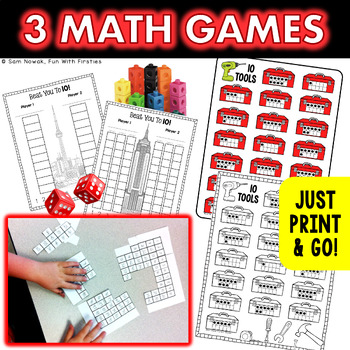
Early Finishers? Math Center Activities? Extra Practice? Whatever the need, these simple math games focus on recognition of numbers 1 to 10, basic one-to-one correspondence, and introduce numbers to 100! They are also a great way to introduce the concept of more and less.
*You can read my original blog post about one of the games HERE and HERE*
HOW TO PLAY EACH OF THE 3 GAMES:
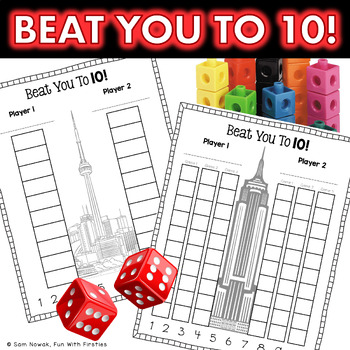
#1 Beat You to 10!
This math game focuses on very basic one-to-one correspondence, counting, and the foundation of addition through the use of visual “more or less” representations. It can be used as a math tub/work station, as an “I’m done, now what?” activity, or anything else you can think of! There are two ways to play:
Option 1: In partners, students take turns rolling a single die and colouring in the corresponding number of boxes on their side (i.e. either the boxes under “Player 1” or “Player 2”). For example, if Player 1 rolls 2 dots on the die, they will colour in 2 boxes. The first player to colour in 10 boxes wins.
OPTION #2: In partners, students take turns rolling two dice, add up the dots, and colour the corresponding number of boxes. For example, if Player 1 rolled 2 dots on one die and 3 dots on the other, they will colour 5 boxes. Obviously this way takes significantly less time to finish the game and reach 10, but it’s a great way to introduce/practice simple addition.
TIP: print the games on cardstock (or back it on colourful construction paper) and laminate it. That way students can colour their boxes with whiteboard markers and play over and over again!
TRICK: You may have noticed the snap cubes pictures on the product cover; When my students play this game, I have them roll the die, then build a tower representing the number they rolled before colouring it in on their worksheet. For example, if a student rolls two dots on the die, they will snap together 2 cubes to begin their tower, then colour in 2 boxes on the worksheet. That way you hit various learning styles by incorporating a hands-on element through building…plus it adds to overall game time.
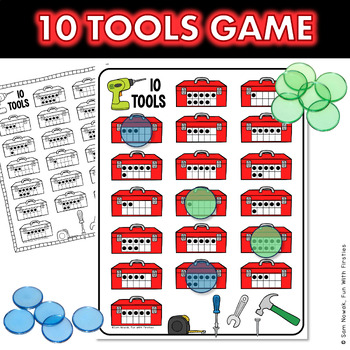
#2 10 Tools
Here is another super simple game to practice addition up to 10, but this time, with the use of 10-frames…yay for subitizing!
You can play by yourself, but it’s more fun in pairs. After you’ve printed the game board (you can also print the coloured version and laminate it for repeat reuse), here’s how to play:
1.Each player will have 10 counters, each their own colour (you can use anything from bingo chips and counting bears, to ripped up pieces of scrap paper). E.g. if Player 1 has 10 blue bingo chips, then Player 2 will have 10 green bingo chips.
2.Play Rock, Paper, Scissors to decide who goes first (PSST: whoever goes first is always the winner but they don’t catch on to this, so make sure they alternate who goes first!).
3.Player 1 will place 1 bingo chip on any of the toolbox ten-frames, then place another on a tool box ten-frame to make 10. For example, if they choose to place their first chip on a ten-frame with 6 dots, then they will place their second chip on a ten-frame with 4 dots.
4.Then it’s Player 2’s turn to place their first bingo chip on any toolbox, then on a second to make 10.
5.Continue taking turns placing down two chips at a time and covering two toolboxes that add up to 10 until all toolboxes are covered. Whoever makes 10 the most wins (i.e. whoever has covered the most toolboxes).
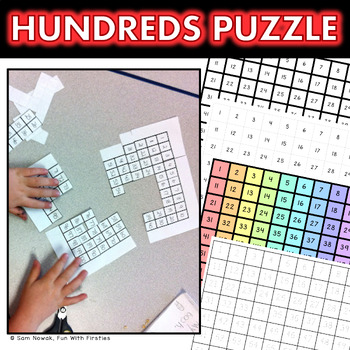
#3 Hundreds Chart Puzzles
Here is one more super easy, low-prep (or no prep, depending on the option you choose!) math game. 100 Chart Puzzles work great as “I’m done, now what?” early finisher activity.
OPTION #1: no prep
•Print off copies of one of the 100 chart (lots of options on the following pages). I suggest coloured paper on the black and white versions to brighten things up!
•Have them available at a station for students to design their own puzzles and cut out according to their own pre-drawn “maze” template
•Once apart, they can work to put it back together either on their own, or switch puzzles with a partner.
OPTION #2: low-prep
•Same as above, but you create pre-made puzzles, each cut up in a different way. In this case, I like to laminate them as well to provide durability and to be able to reuse them year after year.
It’s up to you how difficult or easy you make them (see photo…some have larger parts (i.e. cut up into less pieces), and some have pieces as small as one number.
Happy playing!
☀️ LET’S KEEP THE FUN GOIN’ ⬇️
Follow my store to be notified when new products and freebies are added (just click the ★). PSST…All new resources are 50% off for the first 24-48 hours!
WWW.FUNWITHFIRSTIES.COM
Blog | Instagram | Facebook | Pinterest
➡️ Want free COLOR MONSTER activities sent to your inbox? Click here!